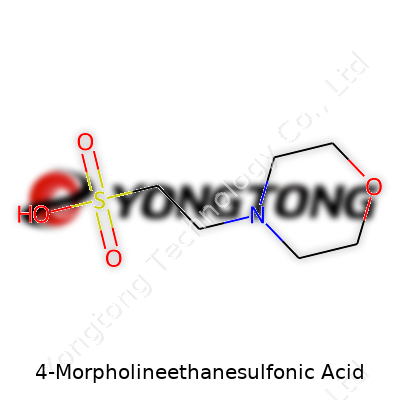
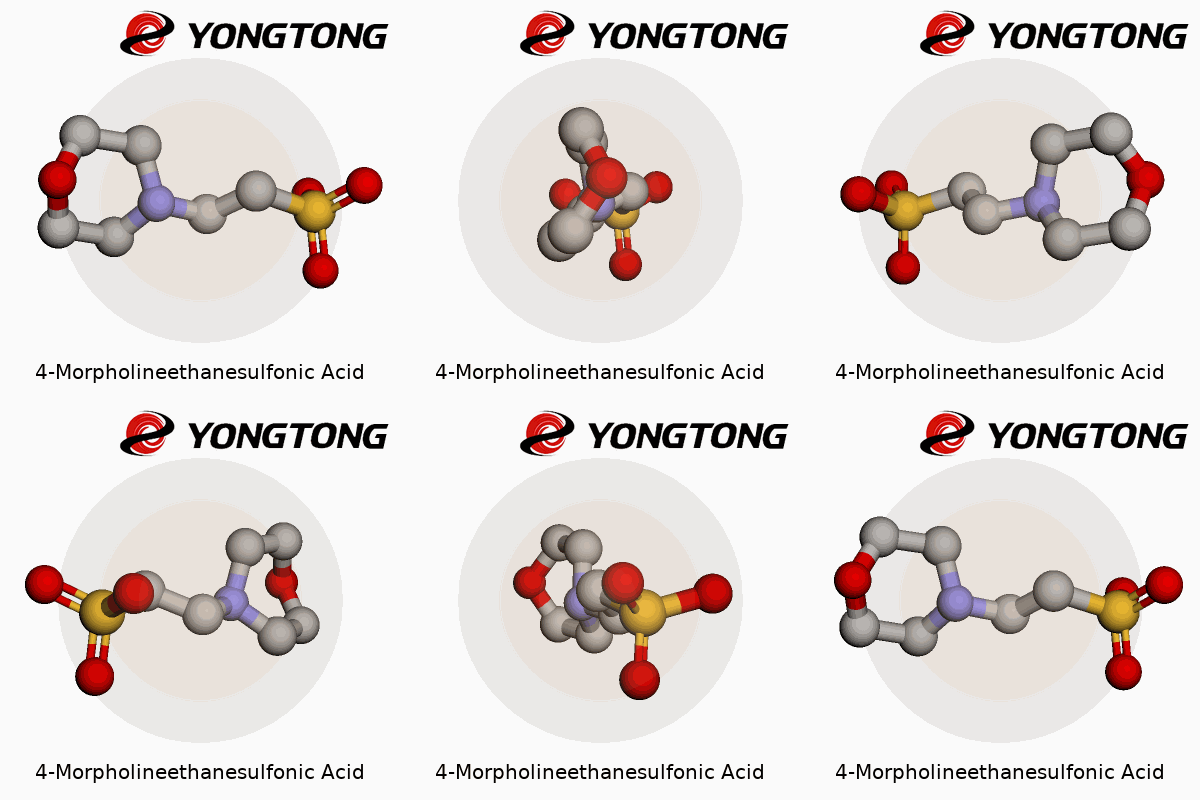
4-Morpholineethanesulfonic Acid: Unveiling Value in Science and Industry
Historical Development
Scientists have always chased after buffers that respect both reliability and simplicity. Way back in the 1960s, researchers laying the foundation for new biochemical methods took their time with 4-Morpholineethanesulfonic acid, which picked up the trade nickname MES. Norman Good, driven by the inadequacy of existing buffer solutions for biological work, helped pioneer MES as part of the so-called “Good’s buffers.” Chemists and biotechnologists have carried forward that legacy; they keep leaning on MES for jobs requiring stable, precise pH control. Watching how a once-specialized discovery became a staple on every lab shelf gives a sense of how slowly, and stubbornly, science improves its toolbox.
Product Overview
These days, 4-Morpholineethanesulfonic acid appears in solid, almost sugary, white crystals. Industry packs it into neat drums or foil bags depending on how sensitive the buyer feels about moisture or light. The powder mixes smoothly with water, pushing no strange odors and offering a kind of practical cleanness that most scientists value more and more as cross-contamination worries grow in labs. Suppliers list it under several aliases, but most people just write “MES buffer”—quick to recognize its structure and purpose without fuss. In a world where time means everything and results need to be trusted, having a buffer that never changes personality under routine storage means fewer headaches and second guesses.
Physical & Chemical Properties
MES stands out by its molecular weight—exactly 213.25 g/mol—providing predictability that matters during recipe calculations. Its melting range, typically landing close to 300℃, signals toughness under regular working conditions. Modern laboratories report that it’s freely soluble in water, which prevents clumps and surprises in buffer preparation. With a pKa hovering near 6.1 at 25℃, MES holds steady across a slightly acidic range—crucial during enzymatic experiments where swings in pH punish protein structure or activity. It resists decomposing in normal temperature and humidity, and shows no reactivity with glass or standard container plastics, which cuts down on waste and costs.
Technical Specifications & Labeling
Certifications today must mean something. Certified MES products come with sharp specs—purity usually hits above 99%, with chloride, heavy metals, and organic residues kept to stubbornly low trace levels. Labels mark batch numbers, analysis data, and expiration dates—no one wants to risk ruined experiments because someone cut a corner. The focus on traceability and consistent documentation means labs can meet ISO and FDA expectations with peace of mind. Safety labeling sticks to global standards, showing hazard statements when needed and offering clear steps for accidental exposure—simple, but non-negotiable.
Preparation Method
Making MES brings together careful chemistry and solid industrial discipline. Synthesis usually starts from morpholine and ethanesulfonic acid or via ethylene oxide, producing the acid by controlled sulfonation in water. Scaling up requires close attention to heat and pressure, since small deviations push yields below commercial interest. Purification leans on recrystallization, using solvents that don’t put excessive strain on the environment or operator health. Modern producers monitor waste streams, pushing for lower emissions and solvent recovery setups to match tightening environmental laws.
Chemical Reactions & Modifications
Professionals turn to MES for more than its base buffering action. Its primary amine reacts gently with aldehydes or activated carboxylic acids, opening a small window for custom buffer derivatives or cross-linkers in chemical biology. Its sulfonic acid group holds up under strong acid or base, so researchers can shift MES buffers through sterilization or high-concentration mixing without risking buffer breakdown or the formation of weird byproducts. Electrophysiologists sometimes tweak the morpholine ring to alter charge or solubility, always with caution since small structural changes can transform performance.
Synonyms & Product Names
The catalog usually points to “2-(N-Morpholino)ethanesulfonic acid” or “MES.” European and Asian suppliers sometimes use “HEPES alternative” when paired with sibling buffers for specific pH spans, causing some confusion for new buyers. Certain biotech catalogs add descriptors such as “UltraPure MES” or “Sequencing-Grade MES” to make distinctions about purity levels. With similar compounds like MOPS and HEPES nearby, a careful read of chemical names saves time; mislabeling leads to setbacks, wasted funds, or even ruined research, so supplier transparency remains critical.
Safety & Operational Standards
Working safely matters more than ever. MES displays minimal acute toxicity based on published animal studies; typical symptoms after major exposure include light gastrointestinal irritation rather than severe poisoning. Even so, good practice calls for gloves and lab coats. Dust generation should be minimized, as respiratory irritation pops up after repeated, careless handling, especially in production plants. Regulatory filings (like Safety Data Sheets) show that MES is not flagged as carcinogenic, mutagenic, or teratogenic, giving users added peace. Disposal runs through local chemical waste programs or neutralization in water followed by biological treatment—no dumping down the drain. Regular training and updated incident logs keep labs on the safe side of legal requirements.
Application Area
MES works in biochemistry, molecular diagnostics, protein purification, sequencing, and even cell culture. Its pKa falls inside the physiological pH window, making it bread-and-butter for studies focused on enzymes, DNA, and fragile cellular environments. Pharmaceuticals lean on MES for its predictable pH during drug formulation and candidate screening. Diagnostic reagent packs—those little cassettes behind rapid viral tests—often build their backbone buffer with high-purity MES to avoid introducing variables. Controlled protein crystallization needs tight buffering, and MES steps up for researchers mapping structure-function relationships. Even teaching labs across universities call on MES as the “default” buffer for student-run experiments.
Research & Development
R&D teams keep challenging the comfort zone. Microfluidics specialists want MES that delivers reliable buffering at micro-scale volumes, so they talk to suppliers about even higher purity and batch consistency. Chromatography and electrophoresis researchers experiment with buffer blends containing MES, searching for sharper separation or higher sensitivity. Interest in climate-positive chemistry encourages new approaches to MES synthesis, cutting waste and power use. Analytics experts now pull thousands of stability tests every year, and some teams use machine learning to predict buffer performance under diverse storage or mixing scenarios—a big leap from traditional, slow, wet-bench testing.
Toxicity Research
Detailed toxicity studies across lab animals and tissue models point toward low bioaccumulation risks and non-toxic profiles at concentrations used in research. Repeat dosing at or above working concentrations reveals minimal systemic changes, although chronic administration in high doses remains rare and poorly studied. Researchers keep a watch on allergic responses, especially in workers with frequent direct powdered buffer handling, but evidence for widespread, serious side effects never showed up in published surveys. For environmental impact, MES does not persist in soil or surface water for long, and it doesn’t show a tendency to interfere with standard water treatment processes. Regulators in Europe and North America keep MES on a “low concern” list, revisiting safety profiles only when large-scale industrial use comes up for re-evaluation.
Future Prospects
Manufacturers and users alike expect demand for MES to grow with surges in life sciences, particularly gene therapy, personalized medicine, and next-generation biochemical assays. Research groups keep developing new, greener synthesis routes—electrochemical processes, solventless reactions, and continuous-flow reactors could replace older, energy-intensive setups. Stakeholders also look at software tools to predict best-use cases for MES, providing more detailed recommendations for buffer selection based on published data and real-world performance. Environmental policy may shift the standards again, driving cleaner production cycles and better recycling for buffer packaging. My own experience points to the real value of MES—reliability, predictability, and the comfort of knowing your buffer won’t become the weak link in months or years ahead as science pushes deeper into the unknown.
Putting Lab Tools to Work
Walk into any busy life sciences research lab and sooner or later you'll run into a bottle labeled “MES.” That’s the abbreviation for 4-Morpholineethanesulfonic Acid—a name that doesn’t exactly trip off the tongue, but whose role makes a difference in how many scientific discoveries move forward. In my graduate lab years, that bottle felt as routine as lab tape, but its absence throws an experiment off track. MES acts as a buffer, keeping the pH in those flasks and plates stable enough for work to happen, especially in experiments running between pH 5.5 and 7.0.
Why Buffers Like MES Matter
Biological research rarely goes far without paying attention to pH. Enzymes, proteins, and even bacteria act differently outside their comfort zones, and more pH swings usually spell disaster. MES holds on to its spot because it doesn’t interfere—a quality you only appreciate after seeing a week’s worth of protein samples ruined by a lesser buffer that reacts in the wrong way. My own efforts to measure cell growth improved once I started using MES, replacing more finicky and reactive choices like phosphate or carbonate. The improvement carried across my team’s results, raising everyone’s confidence in the data.
MES Beyond Basic Science
MES doesn’t live only in university basements. Diagnostic kit manufacturers use MES when they need predictable pH for antibodies and enzymes. Diagnostic strips and test kits at home or in clinics rely on it to avoid false readings, making MES a behind-the-scenes guardian of test accuracy. Having seen these kits rolled out in public health campaigns, I know that a consistent buffer solution matters far beyond the research bench.
Challenges and Pitfalls
No chemical wins on every front. While MES remains trusted, its cost often stands higher than other simple buffers. Small academic labs, working with tight budgets, may see scientists re-using buffer stocks or skimping on quality as a result. Over time, old MES can lose its effectiveness. That tradeoff sometimes roots itself in labs with underfunding issues. Batch-to-batch variation can impact sensitive experiments, making quality control absolutely necessary.
Looking for Better Ways
Reliable chemical suppliers make all the difference. I learned quickly to check certificates of analysis and purity profiles before restocking, especially for MES. This isn’t wasted worry, since a batch with heavy metals or unidentified contaminants can cause errors that only show up later. Science often depends on details like this. Connecting purchasing officers with lab workers also cuts down on procurement mistakes. Open communication about performance and price helps teams find a balance between quality and affordability.
Thinking Ahead
MES keeps research and routine testing on track. By supporting transparency around sourcing, investing in better training on handling, and adding more support for under-resourced labs, researchers can boost the odds of reliable outcomes. Many careers and public health projects lean on these quiet building blocks. Whenever progress in medicine or biology makes the news, chances are good MES helped somewhere along the line.
Science at Work: Breaking Down the Numbers
Molecular weight might seem like a topic only researchers get excited about, but even in a teaching lab, knowing the correct value for 4-Morpholineethanesulfonic acid—often known as MES—saves a lot of troubleshooting. The precise number matters. MES is widely used as a buffer in biological and biochemical research. It provides a stable pH, especially in the range researchers care about, which can really make or break an experiment. The formula for MES is C6H13NO4S. The molecular weight is 195.24 g/mol.
Why the Right Molecular Weight Matters
Grabbing any number from an internet search may lead to mistakes. For buffer prep, every decimal makes a difference. Using the wrong molecular weight leads to inaccurate concentrations and ultimately ruins reproducibility, which forms the backbone of research. Students in the lab often learn the hard way how much a miscalculation can throw off results. This reminds me of an experiment during my undergraduate years: a classmate made a buffer solution and was mystified when a reaction tanked. Turned out, he’d used the wrong value—close, but not quite—and that small slip cost hours of repeat work.
MES in Everyday Lab Work
Anyone who’s worked with proteins knows buffers have personalities. MES stands out because it doesn’t interact much with metal ions or mess with enzyme reactions. It’s more forgiving than some alternatives, but only if you weigh it right. All it takes is one batch with the wrong amount of powder, and the whole series of experiments loses value. A simple digital scale and the correct molecular weight go a long way. MES isn’t expensive or rare, but it’s trusted because it’s reliable—if made right.
Accuracy Is Non-Negotiable in Science
According to the Sigma-Aldrich safety datasheet, 195.24 g/mol sits as the accepted molecular weight. Vendors like ThermoFisher and Merck list exactly the same figure. No debate in the scientific community, no ambiguity. Sticking to the documented numbers keeps experiments honest and easy to reproduce. If someone forgets, one look at the chemical label or the Certificate of Analysis brings up the answer.
Building Good Habits Around Materials Data
Relying on printed handouts or second-hand notes isn’t enough. Keeping updated on reference materials and checking vendor documentation never wastes time. Those fresh to the bench often rely on senior lab members, but making it a personal habit pays off. Printing a quick-reference chart for frequently used chemicals like MES near the bench helps, especially for busy labs with turnover among students and staff. Mistakes drop just by staying consistent with how information gets stored and retrieved.
Improving Research Culture, One Detail at a Time
People sometimes rush to get results, but small things like double-checking a value like 195.24 g/mol keep everything grounded. Science thrives on details. If we want research to move forward and reproducibility to hold up, sticking to the basics—using the right molecular weight, measuring with care, and confirming numbers—matters as much as the big ideas. At the end of the day, the habits built from these details make labs run smoother and keep data trustworthy.
Keeping Chemicals Like 4-Morpholineethanesulfonic Acid Safe
Over the years in the lab, watching the mix of care and hurry people use around their chemicals, it’s become clear that no fancy rules keep everyone safe—good habits do. 4-Morpholineethanesulfonic acid (often called MES) is part of the buffer solutions toolbox, cropping up in biology and chemistry spaces more often than most folks think. It might not scream “danger” like strong acids or solvents, but ignoring its needs can mean ruined experiments, hazards for co-workers, and bills for spilled supplies.
Why Moisture and Air Become Silent Saboteurs
Most MES powder and buffer stocks don’t give much trouble under the right conditions. Left in humid rooms or open to air, though, things head south. Moisture in the air doesn’t just clump the powder; it messes with its buffering power, throwing pH off and rendering a supposedly stable solution unpredictable. Many researchers learn the hard way, seeing their protocols skew because one bottle sat with its lid ajar during a “quick” transfer.
A tightly sealed container keeps out air and accidental splashes. High-density polyethylene bottles with screw tops stand up to frequent use. I’ve seen glass jars chip or corrode over time, but quality HDPE stays steady.
Cool, Dry, and Always Labeled
There’s never been a time storing MES acid in direct sunlight or next to a hot vent ended well. Heat breaks down stability, and a simple shelf in a cool, dim corner goes a long way. Fridges marked “chemicals only” work for longer storage, away from snacks and drinks.
Labels matter just as much as location. Writing the full name, concentration, and date prepared on each bottle removes guesswork. I keep a roll of lab tape and fat-tipped Sharpies at each bench. I’ve seen mistakes happen—someone grabs a faded bottle, assumes the best, and now the buffer ruins a week’s work.
Chemical Segregation: Not Just for the Rulebook
Some people treat shared chemical cabinets like community pantries. MES acid should sit with buffers, not strong acids, bases, or oxidizers. Mixing different classes means incompatible reactions waiting to happen—or, more often, just slow cross-contamination that leaves you scratching your head about why results slowly get worse.
Messy Shelves Lead to Spills
Pouring powders and liquids in the middle of a pile of bottles spells trouble in tight spaces. A clean shelf and a drip tray take two extra seconds but save hours sidestepping puddles and tracking down lids. If a spill does happen, I reach for gloves, wipe up with simple absorbent pads, and toss the waste in a labeled bag—never into the sink.
Keeping It Legal and Safe
Most research labs and companies count on regular checks. Inspecting your stock, checking expiration dates, and logging usage don’t just keep the fire marshal happy—these prevent half-used bottles from becoming mystery hazards over time. I’ve sat through enough safety audits to know: the headache comes from skipping the basics, not from the chemical itself.
Smart Storage Means Fewer Problems Down the Line
Taking a sensible, consistent approach with MES acid helps keep work flowing and protects everyone. Proper storage brings peace of mind the same way locking your door at night does—you might not think about it until something goes wrong, but you’ll be glad you did.
Why the pH Range Actually Matters
4-Morpholineethanesulfonic acid, better known in biochemistry circles as MES, shows up on lab benches any time someone needs to keep a solution at a stable pH—especially around the slightly acidic side. Every researcher who’s prepped a buffer knows the pain of dealing with reactions that swing out of control when the pH drifts too far from the target. MES helps solve that by holding pH steady between about 5.5 and 6.7.
Plenty of experiments depend on picking the right buffer—cell cultures, protein purification, enzyme kinetics. For work with living cells, you want that pH window tight and predictable. Too high or too low, and enzymes stop working right or cells die off. MES fits nicely for systems living just below neutral pH, especially where phosphate complications and heavy-metal contamination don’t belong.
The Science Behind MES Buffer Range
MES buffers solutions where the pKa lands near 6.1 at room temperature. In most real-world experiments, this buffer keeps pH steady between 5.5 and 6.7. Outside that interval, MES loses its grip—both at the low and high ends. This isn’t just theoretical; walk through any life sciences building and you’ll see MES getting snapped up by molecular biologists trying to keep their samples alive and clean.
MES doesn’t complex with most metal ions, which cuts down on unwanted reactivity in sensitive systems. That's something classic phosphate buffers struggle with—especially in plant or bacteria work where metals play a big role. MES steps up for those jobs where your results can’t get skewed by side reactions.
Why Experimenters Choose MES
MES buffer finds a loyal following for protein work. It skips a lot of the side reactions caused by amines or phosphates. Historians in the lab can point to times early protein purification fell apart because of bad buffer choices. MES eventually took the spot because it steadies out the system, doesn’t disrupt most assays, and most enzymes keep ticking without a hitch.
In my own experience with electrophoresis, MES saved a week’s worth of samples when a different buffer threw the pH off after heating. A steady hand on the buffer makes the difference between a publishable result and a wasted experiment.
Challenges and Opportunities
MES can get expensive for large preparations. Some scientists try to stretch buffer solutions past their limit—ending up outside the effective pH window. Measurements lose accuracy and the buffer turns into little more than salted water. Labs that cut corners risk costly repeat experiments. A better approach means investing in calibrating properly and using indicators or meters to confirm the buffer sits at the right pH before kicking off critical assays.
More education around the practical pH limits would prevent a lot of wasted time. Open-access protocols and troubleshooting guides could help students and new lab members avoid rookie mistakes. Science moves faster when the basics—like pH and buffer choice—aren’t a guessing game.
Smart Buffer Choice Gets Results
The right buffer keeps experiments on track. MES, with its working pH window from 5.5 to 6.7, has proven dependable. This knowledge flows best in mentoring, troubleshooting sessions, and team culture focused on hands-on learning instead of trial-and-error. With the right buffer in the right range, success isn’t a mystery; it’s just chemistry done right.
The Role of 4-Morpholineethanesulfonic Acid in Labs
4-Morpholineethanesulfonic Acid, or MES, comes up a lot in laboratory settings. This chemical works well as a buffer, helping control the pH in experiments, especially in biological and biochemical research. Once you spend enough time in labs, you see MES show up next to reagents like Tris or HEPES. This familiarity often leads researchers, students, and lab techs to trust MES without paying attention to its safety details. The comfort level doesn’t make it harmless, though.
Health Impact: What We Know and Don’t Know
MES isn’t classified as highly toxic. Most data suggest it displays relatively low acute toxicity in mammals, based on animal studies and occupational safety resources. Respiratory irritation, minor skin or eye discomfort, and possible digestive upset are the typical symptoms for people exposed without protective gear. This does not mean one can toss MES around without care.
Companies selling MES flag it as an irritant—contact with skin or eyes brings the risk of redness, itching, or burning. Inhaling lots of dust may leave your throat or nose swollen and sore. Anyone with experience in a busy teaching lab has stories about colleagues coughing after mixing MES buffers, dust wafting up on a drafty workbench. Wearing gloves, lab coats, and goggles reduces risk, but skipping those safeguards invites problems quickly.
Environmental Considerations
MES usually gets attention for its role in experiments, not for what happens after pouring it down the drain. MES doesn’t break down quickly in water, which creates questions about long-term impact in aquatic systems. Fish and plant safety data aren’t entirely clear, but most research puts MES in the “low hazard” category for the environment. Many labs still avoid draining MES to stay safe, relying on chemical waste containers and professional disposal services.
I remember long department meetings about chemical disposal budgets. Faculty and safety officers always leaned towards caution, arguing that today’s “low hazard” could end up tomorrow’s regulated contaminant. Evidence from cases where common chemicals ended up harming local groundwater keeps that kind of caution alive.
Regulatory and Workplace Issues
MES sits on most chemical inventory lists with a warning label about handling precautions but does not trigger strict regulatory attention like some solvents or heavy metals. OSHA guidelines for laboratories cover MES under basic chemical hygiene rules. Many facilities post “irritant” pictograms and require safe storage but don’t demand respirators or special containment.
Labs cutting corners by skipping safety training or rushing buffer prep can run into short-term discomfort. Over time, small mistakes add up—skin rashes, accidental spills, inhalation missteps. Accidents rarely involve dramatic poisoning but can ruin a researcher’s day, sometimes longer.
Building a Safer Practice in Everyday Lab Work
Training stands out as the most basic solution. Every new research assistant in our group learns about the real risks of MES before touching a pipette. We keep safety data sheets close, not stuffed in a binder no one reads. Signs over the sink remind everyone not to turn buffers loose in the drain, urging use of dedicated waste bottles even for “non-toxic” chemicals.
Open conversations with chemical suppliers and regular safety audits also help. Commercial suppliers carry a big responsibility to provide up-to-date hazards information—responsiveness from chemical companies makes our jobs easier. Good communication between researchers, supervisors, and support staff drives safe outcomes, and that trust helps everyone focus on work instead of troubleshooting chemical exposures.
Final Word
Handling MES with common sense, actual training, and respectful disposal habits works better than trusting its “low hazard” history. Staying alert to risks—whether for people or water supplies—makes safe, effective laboratory work possible day after day.